So I decided to start writing articles about game design, a subject I’m really into. I believe starting with this topic will be a nice kickstart to this “blog”, since it’s something I researched a while ago for a presentation and is a pretty easy concept to understand, and I hope also easy to explain (I’ll try my best, I swear).
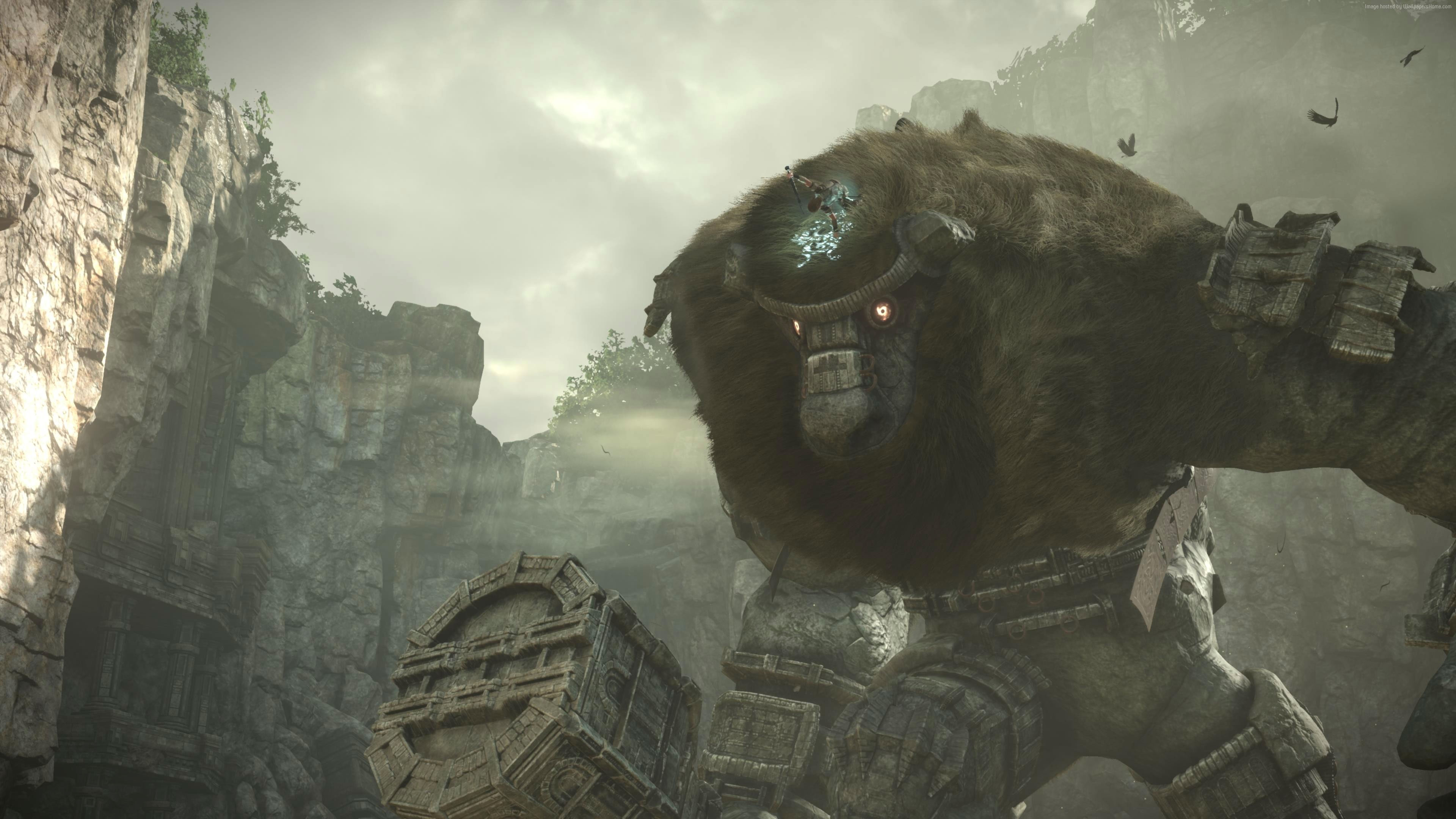
Well then, Shadow of the Colossus. It’s a game everybody knows, and it has been pretty influential for games in the past two generations, inspiring a whole lot of games both in the AAA and indie sectors. Examples of these are Dark Souls (whose also influential creator has gone on record stating that Shadow is a big reference for him and the way he directs his games), Rime, Titan Souls, Journey, and countless others. The game has earned its success by a very broad range of reasons, from being a technical marvel for the PS2, or its atmosphere of desolation, but today I want to talk about the affordance it generates in its players so that the experience of overcoming colossus after colossus is a silky smooth one.
First of all, I want to explain what affordance is. It’s nothing more that how an object communicates the way to use it. For example, when trying to change a remote’s batteries, opening the lid is pretty easy. That’s because when a person looks at it, the small reliefs it has give the necessary information to the user, so that they know that it can be opened, and how. Another example, in this case for videogames, would be how at the start of Half-Life 2 the Combine guard tells you to “Pick up that can”. Earlier, the player has been taught how to interact, an action used to speak with NPCs and open doors, and after that, to pick up objects. Now, however, when interacting with the can, Gordon picks it up and a new prompt, exactly like the one that told us earlier how to interact, now displays how to throw held items. The game has used what it taught us to, first, make sure that we have assimilated that information, and second, to teach us something new. From interacting with NPCs and opening doors to picking up objects to throwing them, all within the span of two minutes. Brilliant.
Moving now to the game at hand today. In the first colossus battle, the player has just learned how to climb, jump and roll, all in a quick little tutorial. If they raise their sword, a blue mark appears on Valus’ left leg. The left leg has hairs that can be climbed which resemble the vines that the player climbed in the tutorial, so the player knows that it can be climbed because of the affordance created by the similarity. Upon climbing it, they might try to climb up further into the colossus’ back, but find it impossible because it is too high up. Thus, if they stab the weak point on the leg, the colossus falls and its back becomes accessible. This creates further affordance in the player: first, that there are two kinds of things that can be stabbed, weak points and sigils (the ones that deal more damage to the colossus when attacked), and second that if one sigil of the colossus is not reachable, find a weak point and attack it, see how it reacts, and probably that will create an access to the rest of the colossus.
For the second battle, the player finds a colossus that doesn’t seem reachable at first sight: Quadratus. Its legs are hairless and there aren't any rocky ledges to grab. That may lead to the player trying to examine the colossus (if he’s a patient one), or shooting it with arrows to see what happens (if he’s not). Either way, Quadratus will try to stomp the player with its front hooves, which reveals them as a weak point. Upon shooting one of them with an arrow, the colossus falls down on that leg, allowing the player to climb to its fur. This shows that sometimes the weak points may only appear when the colossus attacks, or other circumstances. As a side note, this boss introduces the first sigil to be on a part of the colossus with no resting area near it, so it’s a more difficult challenge than the earlier one since the player needs to learn to manage stamina properly.
The third colossus, Gaius, has again no easy access. Thus, we try what worked on Quadratus, waiting for the boss to show a weak spot. Gaius will eventually attempt to splat the player with its “sword”, allowing the character to walk on it up to the titan’s right arm. However, there’s a fragile-looking band of stone that doesn’t allow us to proceed further onto the colossus. Contrasting the pale green of the grass in the ground is a circular stone plate. If the player stands in them, and Gaius hits them with their sword, the impact will shatter the band, providing access to the body of the colossus. Using what we learned earlier, we made the colossus attack us so that we could open a way to their sigils.
What we can learn from Shadow of the Colossus is that, in order to avoid long tutorials, repetitiousness and being condescendent to the player, affordance is a very useful tool. We can make players have fun while learning the mechanics of the game, teaching them further as they play, using what they already know and adding to that little by little. In fact, their perception is that they aren't being taught, they are already doing epic things and slaying huge beasts (with a godlike OST to bakc that up).
Assuring that affordance has been assimilated, and using that to create further knowledge of mechanics is not perceived as a boring tutorial, but as fun, and actually playing the game.
I wrote this originally for a presentation on the Game Design Study Group Discord Server, which you can join here.